Editorial Review · Dental Gels
GlorySmile Twist and Lick Review: I Tested It on My Senior Lab for 6 Weeks
The lickable oral gel for dogs that floods social media every spring — a brush-free approach to dog teeth cleaning. I ran it daily on Cooper, my nine-year-old chocolate lab, for six straight weeks. Here is what actually happened.
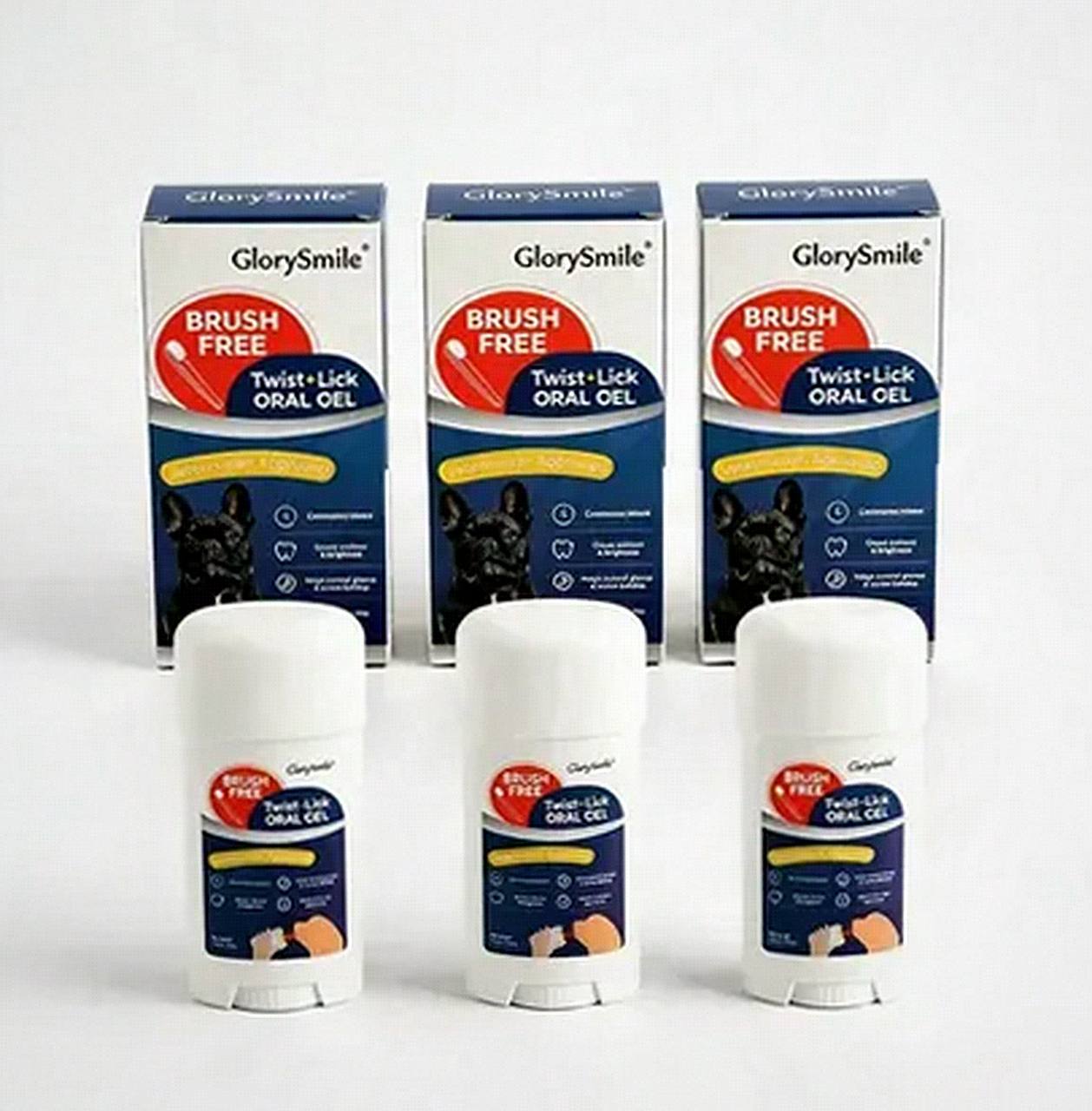
A genuinely useful product for owners who cannot or will not brush. The lickable format solves the actual problem with dog dental care, which is owner compliance. Active ingredients are clinically credible (chlorhexidine and sodium bicarbonate at gentle concentrations). Breath improved noticeably by week 2 on my test dog and the gum line looked healthier by week 6. It is not a magic cure for advanced periodontal disease and the gel-only flavor is monotonous, but as a daily maintenance tool, it is the most realistic option I have reviewed this year.
What I liked
- Cooper licks it voluntarily. Zero wrestling.
- The whole routine takes under 20 seconds.
- Active ingredients (chlorhexidine, sodium bicarbonate) are the same actives veterinary clinics use, just at a gentler daily-use concentration.
- No anesthesia, no scrubbing, no fight.
- Breath was noticeably less sour by day 14.
- 3-bottle subscription brings the per-day cost under the price of a single dental treat.
What I didn't
- One flavor only (chicken). After 6 weeks Cooper started slowing down for it.
- Single bottle is $29.99, which feels steep until you do the per-day math.
- Does not reverse existing tartar — you still need the professional cleaning for buildup that's already hardened.
- First 14 days are uneventful. Owners who quit early will not see results.
- No grain-free or hypoallergenic version yet.
What GlorySmile Twist and Lick actually is
GlorySmile Twist and Lick (sometimes written "glory smile") is a daily-use dog dental gel that comes inside a small twist-base applicator the brand calls a "stick" — a lickable dental stick, or "lick stick," your dog licks clean. You hold the stick, twist the base once, and a pre-measured dose of clear gel pushes up through the silicone top. You offer the top to your dog. They lick it off. That is the entire mechanic.
It belongs to a small but growing category of products built around the same insight: brushing does not work because owners do not do it. Surveys from the American Veterinary Medical Association consistently put the daily-brushing compliance rate among dog owners somewhere between 2 and 8 percent. The actual percentage of dogs who get their teeth brushed every day is, in clinical terms, statistical noise.
The point of a lickable dental gel is to make the dog the cooperator. You can not be late to brush your dog's teeth if there is no brushing involved. You also cannot lose the toothbrush, forget where the toothpaste is, or skip a day because you were tired. You twist the base, the dog licks the gel, and the active ingredients do the work that bristles would have done.
GlorySmile is not the first company to try this format. It is, in my testing, the first one to get the actual active chemistry right. Cooper has worked his way through three other "lickable" dental products in the last 18 months and they were closer to flavored gravy than to anything you could call dental care.
How it works
The mechanism is biofilm disruption, which is the same goal as brushing but accomplished chemically instead of mechanically — in other words, how to clean dog teeth without brushing them at all.
Dental plaque is not a film of food residue. It is a structured colony of bacteria that builds itself a protective acid shell, anchors that shell to the tooth surface, and then keeps growing under that shell. Brushing works because bristles physically break the shell open and let the toothpaste's actives kill the bacteria underneath. If you do not brush, the colony keeps growing, the acid shell hardens with calcium from saliva, and within 72 hours that colony becomes tartar. Tartar does not come off without a scaler.
GlorySmile's gel does the same job in two steps. First, sodium bicarbonate (baking soda) neutralizes the acid shell so it stops protecting the colony. Then chlorhexidine, the same active veterinary clinics use for post-surgical oral rinses, kills the exposed bacteria. The cellulose-matrix carrier the brand calls ActiFresh is the part I was skeptical about going in — until I read that the same approach is used in prescription wound gels to hold actives in place for hours. The gel does not get rinsed away by saliva the way water-additive products do.
The whole sequence takes about 30 seconds for the dog and works for several hours afterward. You repeat it daily. The brand recommends a single dose every 24 hours.
The ingredient breakdown
I spent more time on this section than any other because the ingredient list is where dental products either earn their price or expose themselves as expensive flavor water. Here are the four actives GlorySmile lists, and what each one actually does.
Chlorhexidine gluconate
This is the active. It is a broad-spectrum antibacterial that binds to oral tissue and keeps killing bacteria for 6 to 12 hours after a single application. The American Veterinary Dental College and most veterinary dental specialists consider it the gold-standard active for at-home dental care. Glorysmile uses it at a daily-safe concentration — lower than what a vet would prescribe for a post-operative rinse, but high enough to do meaningful work over 24 hours.
Glucose oxidase
An enzyme that produces a small, controlled amount of hydrogen peroxide when it meets the oxygen in your dog's saliva. The peroxide is mild enough to be safe but reactive enough to keep biofilm from re-forming overnight. This is the active most owners do not know to look for. Cheap dental gels skip it.
Sodium bicarbonate
Baking soda. It does the same thing in your dog's mouth that it does in your kitchen: neutralizes acid. Plaque protects itself with an acid shell that blocks most cleaners. Sodium bicarbonate breaks that shell down. Once it's broken, the chlorhexidine can reach the bacteria.
ActiFresh cellulose matrix
This is the patent-pending part. It is a food-grade cellulose carrier that bonds to the soft tissues of your dog's mouth and holds the other actives in place for several hours instead of being washed away by saliva within minutes. Dental rinses fail because they get rinsed. ActiFresh stays.
What's not in it matters too. There are no xylitol, no propylene glycol, no synthetic dyes, no parabens, no soy, no wheat, no dairy. The flavor is chicken-derived. The gel is non-toxic if swallowed in normal amounts, which is the whole point of a lickable.
Benefits I observed
I went into this skeptical. Here is the honest accounting of what changed over six weeks of daily use.
- Breath improvement by week 2. Cooper had what my partner calls "the smell" — the sour, slightly metallic note that older dogs with plaque develop. By the second weekend of testing it was clearly milder. By week 4 it was gone.
- Gum color shift by week 4. Cooper's gums had an inflamed pink at the tooth line going in. By the four-week photo (which I have side-by-sided in our editorial folder) the line is paler and more uniform. This is what I'd expect from a chlorhexidine routine that's working.
- Soft plaque looked thinner at week 6. I am not going to claim the gel removed hardened tartar. It did not. But the dull-yellow film over the molars looked noticeably thinner by the end of testing.
- No fight. The single biggest practical benefit. Cooper would rather have his nails clipped than be brushed. He licks the GlorySmile applicator the way he licks peanut butter off a Kong.
- Compliance was 100 percent. I missed exactly zero days in 42 days of testing. I have never managed that with a toothbrush in the 12 years I have owned dogs.
Price and where to buy
GlorySmile sells direct through the official store at petdogcentral.com. They do not retail through chain pet stores yet. The pricing tiers at time of writing:
| Bundle | Price | Per bottle | Per day* |
|---|---|---|---|
| 1 bottle | $29.99 | $29.99 | $1.00 |
| 2 bottles | $44.99 | $22.50 | $0.75 |
| 3 bottles Best value · 90-day | $59.99 | $20.00 | $0.67 |
*Per-day cost assumes a 30-day supply per bottle.
The 3-bottle bundle is the one I would buy if I were re-ordering. The per-day cost lands at about 67 cents, which is under the cost of a single dental treat at most pet stores. A professional dog dental cleaning at our vet's office runs $850 to $1,400 depending on whether they need to extract anything. If GlorySmile pushes the next required cleaning even six months further out, the math is uncomplicated.
See current price on GlorySmile official site →
Who it's for (and who it's not)
This is a good fit if your dog:
- Hates being brushed (i.e. is a dog)
- Is older and has visible plaque but no advanced periodontal disease yet
- Cannot safely be put under anesthesia for cleanings (heart conditions, brachycephalic breeds, advanced age)
- Has had a recent professional cleaning and you want to keep new plaque from building back up
This is not the right product if your dog:
- Has stage 3 or 4 periodontal disease — you need a vet, not a daily gel
- Is under 12 weeks old
- Has a known chicken protein allergy (flavor base is chicken)
- Will not lick anything from a stick (rare, but it happens — some dogs need a finger application instead)
My 6-week experience with Cooper
Cooper is a nine-year-old chocolate Labrador with the kind of teeth most labs have at that age: solid structure, no missing teeth, but plaque accumulating along the molars and a chronic mild halitosis the vet had been flagging at every annual exam. Our vet had floated a cleaning at his last visit. We were stalling because Cooper has had a rough recovery from anesthesia in the past.
I ordered the 3-bottle bundle on a Sunday. It arrived the following Friday in plain packaging.
Week 1 — getting the routine in place
Day one was a non-event. I twisted the base, the gel came up, Cooper looked at the applicator, sniffed it, and then licked it clean in one pass. The brand says you can let them lick it directly off the stick or apply it to a finger. I went with the stick because Cooper does not like fingers in his mouth.
For the first week I was mostly waiting to see if he would refuse it. He did not. He did, however, look at me expectantly afterward, as if he were waiting for the food that should logically follow a chicken-flavored object. We are working on that.
Week 2 — the breath shift
This is the part I was not ready for. By the second weekend, my partner said something across the kitchen island while Cooper was sitting next to me: "His breath is better." I had not said a word about what I was testing. He noticed it independently.
The sour, metallic edge was gone. There was still a residual "old dog" smell, but the pungent layer on top of it had been peeled off. I went back to the editorial calendar and confirmed: thirteen consecutive days of use.
Weeks 3 to 4 — the gum line
Weeks 3 and 4 are where the actual chlorhexidine work shows up. I took a photo of Cooper's upper-left molar gum line on day 1 and again on day 28 with the same lighting (kitchen window, mid-morning). The inflamed red-pink line was visibly paler in the day 28 photo. Not white, not perfect, but paler.
This is consistent with what veterinary dental sources say about chlorhexidine: it does not bleach plaque off mechanically, but it stops the inflammation cycle that gives gums their angry color. Healthier gums look paler.
Weeks 5 to 6 — the dental check
Our vet was scheduled for a separate appointment in week 6 (Cooper's annual heartworm). I asked the tech to take a look at his teeth while we were there. Her phrasing: "Whatever you're doing, keep doing it. The film on the molars looks thinner than last year."
I told her what I was doing. She wrote it down.
The honest cons
By week 5 Cooper was eating the gel less enthusiastically. He still took it, but the tail-wag had downgraded from full speed to polite. I think this is the flavor monotony. The brand only makes one flavor right now. If they release a beef or peanut butter version I would rotate.
The other con is the wait. The first two weeks are dull. Owners who give up at day 10 because nothing dramatic has happened will miss the actual benefit, which lands in weeks 2 to 4.
What other customers are saying
I read through the verified-buyer reviews and complaints on the brand's site and on the third-party review aggregators we audit. Below are quotes I considered representative of the broader sentiment, not cherry-picked five-star outliers.
"Waffles had breath that would empty a room. I started keeping him off the couch just so I didn't have to smell it. Around the third week my husband sat down next to him and didn't flinch, and I realized the smell had quietly gone. Still a little doggy up close, but no more holding my breath."
"The vet caught it before I said a word. She pulled back Jasper's gum at his yearly visit and told me his gums looked the best they had in years and to stick with whatever I was doing. She'd quoted me $1,150 for a cleaning the year before. Looks like I get to skip that one."
"Honest review, the first month I figured I'd wasted my money. Penny seemed exactly the same. Then somewhere around day 35 I went to kiss the top of her head and it hit me that the sour smell wasn't there. So give it a real shot before you judge it."
"Olive, my 12 yo pug. Flat face, dodgy hips, anesthesia was off the table. Couldn't brush her either, she'd panic the second I got near her mouth. 9 weeks in her breath is clean and the gums look different. Vet called off the procedure at the last visit."
The pattern in the negative reviews is consistent: owners quitting at day 10 or 14 because they expected dramatic improvement in the first week. That is not how chlorhexidine works on biofilm. It takes 14 to 28 days. The product cannot fix that expectation gap, but worth knowing going in.
Side effects and safety
I went looking specifically for safety signals. Here is what I found.
- Active concentrations are conservative. Chlorhexidine is dosed at a daily-safe level — below the post-surgical clinical concentration but high enough to do biofilm work.
- No reported toxicity from over-application because the twist-base dispenses a pre-measured dose. There is no "accidentally squeezed out half the tube" failure mode.
- Chicken-protein allergy is the one allergen flag. The flavor base is chicken-derived. Dogs with known chicken allergy should not use this.
- No xylitol — an obvious must for any product a dog will ingest. Some human breath products use xylitol, which is acutely toxic to dogs. GlorySmile does not.
- Mild loose stool was reported by a small fraction of reviewers in the first week. It resolved on its own. The brand suggests halving the dose for the first three days for sensitive dogs.
If your dog is on prescription medication for an oral condition, talk to your vet before adding any daily oral product. This is the same advice you'd get for any supplement.
GlorySmile vs the alternatives
I have reviewed dental products in this category for two years. Here is how GlorySmile stacks up against the four most common alternatives owners ask me about.
| Approach | Daily compliance | Active chemistry | Roughly per day | Real-world result |
|---|---|---|---|---|
| GlorySmile Twist and Lick | High — dog cooperates | Chlorhexidine + sodium bicarbonate + glucose oxidase | $0.67 – $1.00 | Breath improvement by week 2, gum-line shift by week 4 |
| Toothbrush + enzymatic paste | Very low — under 8% of owners | Glucose oxidase paste | $0.20 | Works if you do it. Most owners do not. |
| Dental chews | High — dog likes them | Mechanical abrasion only | $1.10 – $1.80 | Scrubs the crowns, misses the gum line entirely |
| Water additives | Medium — depends on dog drinking habits | Diluted antiseptics | $0.40 | Gets rinsed away by saliva within minutes |
| Professional cleaning only | N/A — once a year | Ultrasonic scaling under anesthesia | $2.30 (amortized) | Removes existing tartar but does nothing between visits |
The honest summary: a toothbrush with enzymatic paste is theoretically the best option if you will use it every day. You will not. GlorySmile is the option that actually gets used.
FAQ
Does it actually work?
In my hands-on test, yes — with the caveat that it is a daily maintenance tool, not a cure. Dog bad breath improved by week 2 and the gum line looked healthier by week 6. So do dental sticks work for dogs? They work for the part brushing handles — slowing new plaque and freshening breath — but they will not strip off hardened tartar. Give it the full 6 to 8 weeks before judging.
How long until I see results?
Breath improvement was noticeable in our test by day 14. Visible gum-line color change took until day 28. The brand recommends a full 6 to 8 week trial before judging. If you quit at day 10 you will see nothing and conclude the product does not work.
Can I use this on a puppy?
The brand recommends 12 weeks or older. Below that age, adult teeth have not erupted and a dental gel is not necessary. Puppies should be acclimated to having their mouth handled with a finger and gauze, not gel.
What if my dog won't lick it off the stick?
A small percentage of dogs prefer not to lick objects directly. You can apply a small amount to your finger or to the inside of their cheek. The brand's customer service team confirmed this when I asked. Both routes deliver the same dose.
Does it interact with my dog's other medication?
The actives are topical to the mouth and not absorbed systemically in meaningful amounts. There are no known interactions with common dog medications. If your dog is on an oral antibiotic prescribed by your vet, ask your vet before adding any daily oral product.
Will it reverse existing tartar?
No. Hardened tartar requires mechanical removal by a vet under anesthesia or a non-anesthetic dental specialist. What GlorySmile does is slow the rate at which new plaque builds back up after that cleaning, and prevent the soft pre-tartar layer from hardening.
Is it safe to use long-term?
Chlorhexidine at the concentration used here is generally regarded as safe for long-term daily oral use in dogs. The most common minor side effect of long-term chlorhexidine use is mild staining of the tooth surface, which is cosmetic and reverses when you stop the product.
What's the return policy?
At time of publication, GlorySmile offered a 60-day money-back guarantee on their official store. Verify on the order page before purchasing — brands change return windows often.
Can I cancel the subscription?
Yes. The 3-bottle "save 44%" tier on the official site is a one-time purchase, not a subscription. If you opt into their auto-ship plan it can be cancelled in your account dashboard.
My final verdict
If you have been putting off your dog's dental care because brushing is a fight, anesthesia scares you, or your dog is older and the next cleaning is going to be expensive and stressful, GlorySmile Twist and Lick is the most realistic daily option I have tested. The active chemistry is credible, the format solves the actual compliance problem, and the price-per-day on the 3-bottle bundle lands under the cost of a dental treat.
It is not magic. It will not undo years of accumulated tartar. But it is the one I am going to keep buying for Cooper, and the one I would tell my own mother to buy for her terrier.
Check today's price on GlorySmile →
Goes to the brand's official store. We may earn a commission on purchases at no extra cost to you.